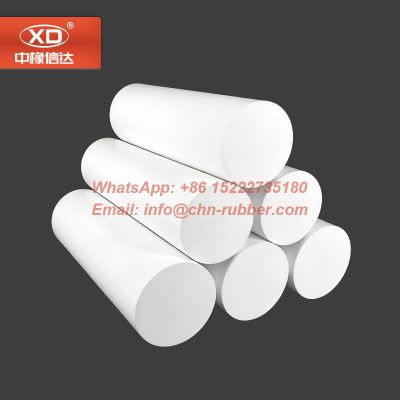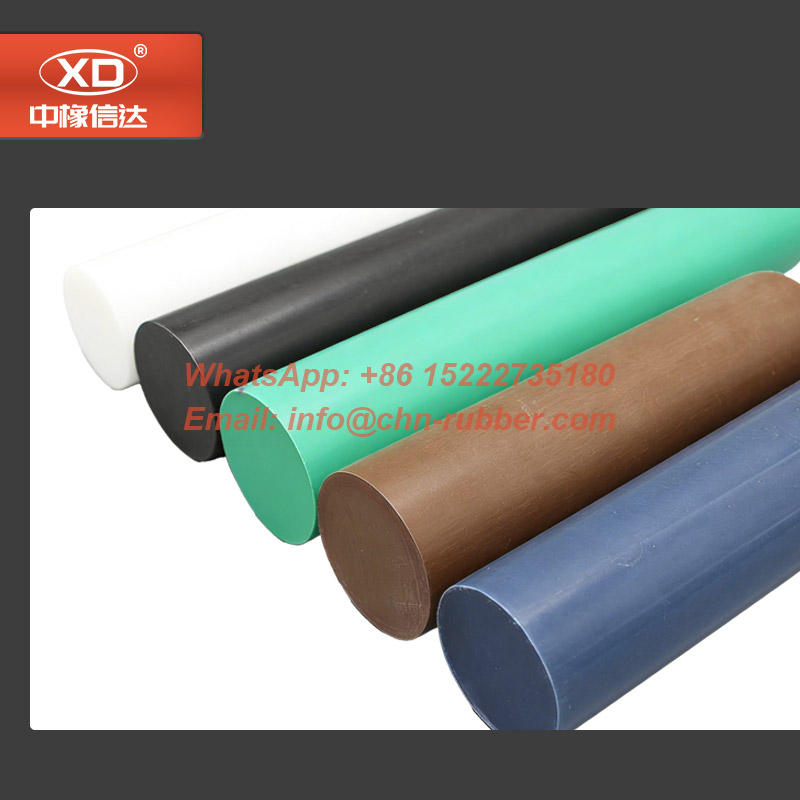
10% 25% Glass Bronze Mineral Filled PTFE Rod
High-performance PTFE rod enhanced with customizable fillers, including but not limited to glass, bronze, or mineral additives. Fillers are uniformly integrated to improve mechanical strength, reduce creep, and enhance wear resistance, while retaining PTFE’s exceptional chemical inertness and low friction properties.
- Filler type and content adjustable according to specific application requirements
- Optimized dimensional stability under load and high temperature
- Superior abrasion and wear resistance compared with unfilled PTFE
- Maintains excellent low-friction, non-stick surface performance
- Ideal for CNC machining into bushings, valve seats, guide rings, and structural components
Request a Sample and Quotation:
WhatsApp: +86 15222735180
E-mail: info@chn-rubber.com
Filled machining PTFE rod is produced by room-temperature compression molding of PTFE powder with selected fillers, followed by controlled sintering. The fillers—customizable in type and concentration, including but not limited to glass, bronze, and mineral—are homogeneously distributed throughout the PTFE matrix, enhancing the rod’s mechanical and thermal performance without compromising chemical resistance or non-stick properties.
In industrial applications, filled machining PTFE rods are produced using the following methods. Common filler types and typical addition ranges are as follows:
- 10% – 25% Glass Fiber Filled PTFE
- 40% – 60% Bronze Filled PTFE
- 10% – 35% Carbon Filled PTFE
- 5% – 15% Graphite Filled PTFE
- 15% Carbon + 5% Graphite Filled PTFE
Key Technical Features:
- 1. Customizable Fillers: Glass, bronze, mineral, or combinations thereof; content adjustable to balance strength, wear resistance, and thermal stability according to application requirements.
- 2. Dimensional Stability: Controlled filler distribution reduces shrinkage during sintering and machining, providing predictable tolerances for critical components.
- 3. Mechanical Performance: Improved ptfe round bar hardness, compressive strength, and creep resistance compared to unfilled PTFE, enabling longer service life in high-load environments.
- 4. Thermal & Chemical Resistance: Maintains integrity under continuous exposure to temperatures up to 260°C and aggressive chemical media.
- 5. Machinability: Even with high filler content, the ptfe round bar can be precisely turned, milled, or drilled for bushings, valve seats, guide rings, and structural spacers.
- 6. Wear & Friction: Fillers enhance abrasion resistance while preserving PTFE’s low friction and anti-stick behavior, minimizing maintenance in moving or sliding applications.
Industrial Applications:
- 1. High-performance seals, gaskets, and valve components in chemical processing and fluid-handling systems
- 2. Bearings, bushings, and guide rings requiring extended wear life and dimensional accuracy
- 3. Structural spacers, insulators, and support components exposed to combined thermal, mechanical, and chemical stress
- 4. Customized components where filler type, concentration, and rod dimensions are engineered to meet specific design requirements
Customization Options:
- Filler type and content tailored to optimize strength, wear resistance, or thermal performance
- Diameter, length, and tolerance grades produced according to engineering drawings
- Special processing available for enhanced surface finish or critical dimensional accuracy
Filled PTFE rods provide a reliable, engineered solution for demanding industrial environments, combining the chemical and thermal advantages of PTFE with enhanced mechanical and wear properties.