When sourcing polytetrafluoroethylene for heavy-duty industrial applications, procurement professionals and engineering teams frequently encounter a critical decision: should they specify a skived configuration or opt for a static molded slab? While both formats leverage the exceptional properties of raw fluoroplastics—such as universal chemical inertness, extreme thermal resistance (-180°C to +260°C), and a near-zero friction coefficient—their underlying manufacturing methodologies impart distinct mechanical differences.
Choosing the wrong configuration can lead to material waste, processing complications during custom gasket cutting, or premature component failure under severe operational loads. As an established, data-driven ptfe sheet manufacturer, we have compiled this comprehensive guide to analyze the structural characteristics of skived vs molded ptfe sheets, empowering you to make an optimized material selection for your next engineering deployment.
Understanding Precision Skived PTFE Sheets & Rolls
The skiving process is essentially a continuous slicing technology. It begins by compressing raw virgin PTFE resin into a massive solid cylindrical billet, which is then dynamically cured through precise thermal sintering cycles. Once cooled, this billet is mounted onto advanced, heavy-duty CNC horizontal peeling lathes. As the billet rotates at a regulated speed, an ultra-sharp linear blade shaves off a continuous, uniform layer of plastic at highly accurate geometric tolerances.
This peeling method yields thin, highly flexible virgin ptfe sheet rolls, typically ranging from a microscopic 0.1 mm up to a robust 10 mm in thickness. Because the material is produced in a continuous ribbon, it offers significant layout advantages for large-scale operations. For example, specialized processing lines can manufacture extra-wide skived ptfe sheets spanning up to 4000 mm (4 meters) in width. This extra-wide configuration is crucial for chemical tank linings and vessel protection, as it minimizes layout seams, eliminates joint-welding vulnerabilities, and drastically reduces the risk of hazardous chemical permeation.
Understanding Heavy-Duty Molded PTFE Plates & Slabs
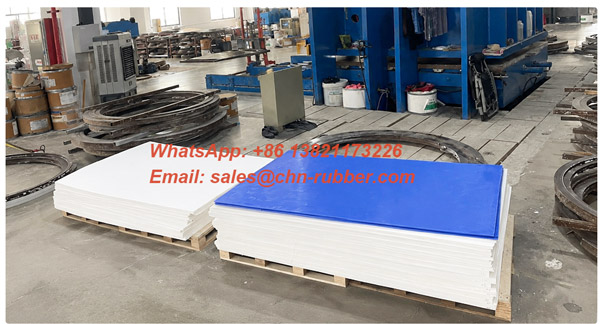
In contrast to the continuous lathe-peeling technique, the manufacturing of molded ptfe plates relies on static, high-pressure hydraulic compression. Loose, un-sintered fluoroplastic powder is poured directly into rigid rectangular steel molds. Massive hydraulic rams subject the compound to immense pressures, packing the particles into a dense, pre-formed block. This green block is then carefully transferred to computer-regulated sintering ovens, where it undergoes a slow, controlled heating and cooling cycle to cross-link the polymer chains fully.
Molding is the definitive choice for thick, rigid cross-sections, with standard outputs ranging from 3 mm up to 100 mm or more. Because the material is cured under uniform, multi-directional static pressures within a fixed frame, molded slabs exhibit excellent isotropic mechanical integrity. They possess virtually zero internal tensile stresses and show equal strength profiles across both the longitudinal and transverse axes. This structural homogeneity makes them perfect for precision machining into heavy structural components, valve seats, and slide bearings.
Direct Engineering Comparison Matrix
To assist your technical teams during the initial design and specification phases, here is a direct breakdown of the physical differences between the two production formats:
| Technical Parameter | Precision Skived Format | Heavy-Duty Molded Format |
| Thickness Availability | 0.5 mm to 10 mm (Thin, flexible) | 5 mm to 300+ mm (Thick, rigid) |
| Delivery Configuration | Continuous rolls or cut sheets | Flat, rigid square/rectangular plates |
| Tensile Elongation | Higher along the peeling direction | Balanced, isotropic distribution |
| Best Suited For | Gasket punching, thin liners, wraps | CNC machining, heavy load pads, seals |
Application Mapping: Matching Project Criteria to Material Format
To maximize the operational life cycle of your fluoroplastic components, align your specific application parameters with the inherent strengths of each manufacturing style:
When to Specify Precision Skived Material:
- High-Volume Die-Cutting: If your plant uses high-speed stamping presses or automated flatbed plotters to produce thin custom ptfe gaskets for piping flanges, skived rolls provide an uninterrupted material feed that drastically reduces cycle times.
- Curved Surfaces & Vessel Lining: Because thin skived stock retains exceptional pliability, it can easily contour around tight radii, complex geometric curves, and internal chemical reactor walls without cracking or introducing stress points.
- Dielectric Insulation Wraps: Skived tapes and thin films provide superior voltage insulation and uniform thickness control across wires, electrical busbars, and capacitors.
When to Specify Rigid Molded Material:
- Heavy Machining & Custom Lathe Turning: If your project requires secondary CNC turning, drilling, or milling to produce complex components like valve seats, heavy-duty mixers, or laboratory manifolds, molded slabs provide the dimensional stability needed to maintain strict geometric tolerances.
- High Load-Bearing Infrastructure: Slide bearings, structural bridge expansion pads, and heavy pipe guides operating under continuous high compressive loads require the high density and creep resistance of molded plates.