Executive Summary (Key Takeaway): Selecting the right PTFE grade is critical for industrial fluid handling and gasket fabrication. Virgin PTFE is manufactured from 100% pure fluoropolymer resin without any reprocessed content, offering superior tensile strength (≥ 25 MPa), high elongation (≥ 300%), excellent dielectric strength, and full RoHS compliance. In contrast, Recycled (Mechanical Grade) PTFE incorporates reground scrap material, leading to lower tensile strength (10–15 MPa), micro-porosity, and inconsistent density. In high-pressure, thermal-cycling, or corrosive chemical applications, using recycled PTFE significantly increases the risk of gasket creep, stress cracking, and catastrophic seal failure.
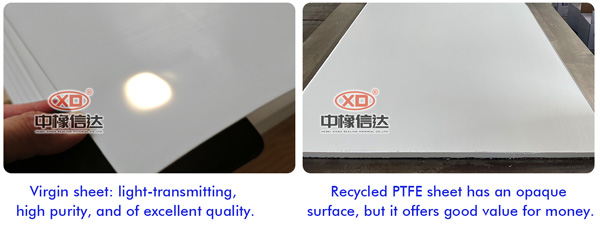
1. Technical Comparison: Virgin PTFE vs. Recycled (Mechanical Grade) PTFE
When evaluating PTFE sheet materials for die-cutting gaskets or machine components, engineers must compare physical properties rather than looking at initial material cost alone.
| Physical & Mechanical Property | Virgin PTFE Sheet | Recycled / Mechanical Grade PTFE | Impact on Gasket Performance |
| Resin Content | 100% Pure Virgin PTFE Resin | Contains Reprocessed/Reground Scrap | Purity determines chemical inertness and lifecycle. |
| Tensile Strength | ≥ 25 – 30 MPa | 10 – 15 MPa | Low tensile strength leads to gasket blowouts under pressure. |
| Elongation at Break | ≥ 300% – 350% | 100% – 150% | High elongation allows gaskets to conform without cracking. |
| Density | 2.15 – 2.20 g/cm³ | Inconsistent (2.05 – 2.15 g/cm³) | Inconsistent density creates micro-leakage paths. |
| Dielectric Strength | High (≥ 40 kV/mm) | Moderate to Low | Recycled grade may contain conductive metallic micro-impurities. |
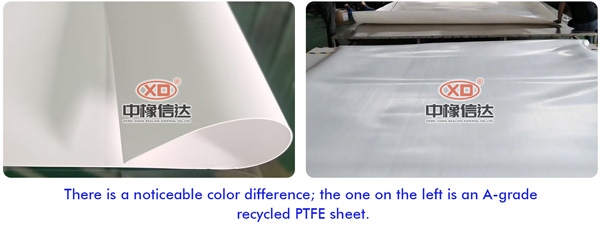
| Color & Appearance | Pure Milk-White | Off-white, yellowish, or specs of dark grey | Visible indication of reprocessed thermal history. |
| Regulatory Compliance | RoHS / REACH | SGS | Critical for pharmaceutical, food & beverage processing. |
2. Hidden Risks of Using Recycled PTFE in Industrial Sealing
1. High Risk of Flange Blowout Under Thermal Pressure
During operation, pipe flanges experience thermal expansion and pressure spikes. Virgin PTFE retains structural elasticity under load. Recycled PTFE—having undergone multiple thermal processing cycles during regrinding—suffers from severe polymer chain degradation. Under high bolt torque and elevated pressure, recycled PTFE gaskets lose stress retention, resulting in unexpected flange blowouts.
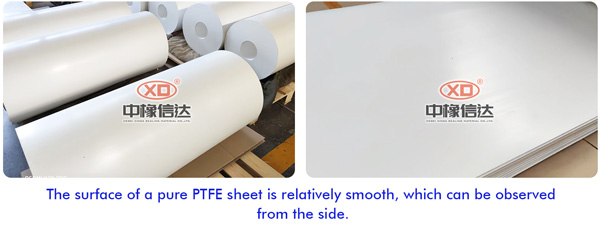
2. Micro-Porosity and Chemical Permeation
Gaskets machined from recycled PTFE sheets often contain microscopic voids caused by non-uniform sintering of reground particles. While a recycled sheet might pass a basic hydrostatic test initially, corrosive chemicals, gases, or steam will gradually permeate through these micro-pores over time, accelerating flange bolt corrosion and environment contamination.
3. Accelerated Cold Flow and Creep Deformation
All PTFE materials exhibit some degree of cold flow under continuous compression. However, recycled PTFE creeps at a rate 2x to 3x faster than 100% virgin PTFE. Once the gasket compresses beyond its elastic recovery limit, bolt torque drops, causing gradual leakage across pipeline joints.
4. How Gasket Fabricators and Buyers Can Verify 100% Virgin PTFE
To protect your equipment and avoid customer claims, procurement teams should mandate strict quality verification checks before accepting shipments:
- Request Mill Test Certificates (MTC): Ensure tensile strength and elongation are certified per ASTM standards.
- Inspect Material Surface Color: Pure virgin PTFE has a uniform, bright milk-white appearance. If the skived sheet displays grey specks, yellowish tinting, or uneven translucency, it likely contains reprocessed scrap.
- Verify Thickness Tolerance: Die-cutting operations require tight tolerances (e.g., ± 0.05 mm for thin skived sheets). Reprocessed PTFE sheets often exhibit variable density, causing uneven sheet thickness during skiving.
5. Industry Application Recommendations
- Use Virgin PTFE For: High-pressure chemical pipelines, pharmaceutical processing, food contact equipment, high-voltage electrical insulation, and critical valve seat rings.
- Recycled PTFE May Only Be Suitable For: Low-pressure static spacers, non-critical construction shims, or non-corrosive drain pipe washers where food contact and high pressure are not factors.
6. Frequently Asked Questions (FAQ)
Q1: Is Virgin PTFE suitable for food contact and pharmaceutical piping?
A: Yes. However, our virgin PTFE has not undergone FDA 21 CFR 177.1550 testing; we can conduct FDA testing upon customer request.
Q2: What thickness tolerances should I specify when purchasing PTFE skived rolls for automated gasket cutting?
A: For precision die-cutting or CNC knife cutting, specify a thickness tolerance within ± 0.05 mm to ± 0.10 mm. This ensures clean cutting edges without crushing or knife jamming.
Q3: Can filled PTFE (e.g., 25% Glass-Filled) be considered Virgin PTFE?
A: Yes, provided the base PTFE resin used before compounding with glass fiber, carbon, or bronze powder is 100% virgin polymer resin. Filled grades enhance wear resistance and reduce cold flow while maintaining high thermal stability.